Wednesday, February 27, 2008

Cool Deep Sea Stuff

I thought this was the coolest chapter in my Marine Biology book, so I had to share it :). The area beneath the epipelagic (Which is the area around the surface of the water down to around 200 meters) is divided into two areas: the mesopelagic and the deep sea.
The mesopelagic receives enough light for organisms to see each other, but not enough to support photosynthesis. So, as you can guess, there isn't much primary production here, and so there aren't many creatures here. Although phytoplankton can't live here, zooplankton can. They have photophores, which are are organs that produce light (I'll talk more about them later). The mesopelagic also does not receive many nutrients from other ecosystems either. Because food is so scarce here, most creatures need to be able to eat whatever they find. Most creatures use a sit and wait tactic, where they sit around and wait for food to come to them. This is benificial because it doesn't use up much energy and they don't need a lot of muscles. A lot of organisms have large mouths and hinged jaws so they can eat large organisms. Mesopelagic creatures also migrate vertically up into the epipelagic at night to get food and return during day so they aren't eaten.
Many organisms in the mesopelagic are silver, black, red, or transparent. Many fishes use photophores on the undersides of their bodies so that their silhouette, when viewed from below, is broken up. This is called counterillumination. The photophores do not simply turn off and on like light switches, but get dimmer in darker areas, and get brighter in lighter areas. This light is produced by a chemical reaction between luciferin and luciferase. Luciferin reacts with oxygen, and luciferase acts as a catalyst and speeds up the reaction. What's really neat about this light is that it's cool: this light does not produce heat.
The deep sea is similar to the mesopelagic, except more so. There is more pressure in the deep sea, there is absolutely no light here, and there are even less organisms. Many deep sea fishes can eat prey much larger than themselves. On the deep sea floor, the food that floats down from above zones stays there until it is found and decomposed. There are hydrothermal vents in certain areas. These vents are hot, actively spreading rift zones where heated water spews up from the crust. Around these hydrothermal vents live all sorts of creatures. This is because some types of bacteria can produce nutrients from the chemicals spewed from the vents. There are other vents which are called cold seeps, which are cold instead of warm.
So, that's a quick summary of the chapter I just finished in marine biology. Here are some pictures too:
Anglerfish

Dragontail Fish
Threadtail fish

A couple of modules ago, I started raising brine shrimp (also called sea monkeys) for an experiment. The first generation died several weeks ago, and now the second generation is at its height (they're really fun to watch, because their little feet flutter wildly as they swim around :D)
Here are some pictures. They're kind of hard to see, so you might want to right click on the picture and click on view image to get the biggest picture. They're not the little round things (those are the eggs).


And I also finished painting some miniatures recently. Here are pictures:


Wednesday, February 6, 2008

Wood Elves

So...for Christmas, JD got me a box set (24 miniatures) of plastic wood elves. They were very interesting to paint, as I've never painted anything like them before. I thought they turned out fairly well, except some of their faces didn't look very well. Here are a few pictures:

Also, something else I found on randomly browsing the internet. :P
Go to Google and type 'find chuck norris' without the quotes and then hit I'm feeling lucky.

Wednesday, January 16, 2008

Coral Reefs

Yeah, it's been a while. And I've been studying a lot of things in marine biology that I don't really have time to talk about right now. I will, however, talk about something I just finished studying about: coral reefs.
So, you may be wondering, what is a coral reef? Well, it's a bit complicated. What you see, touch, etc. is the limestone "armor" that is secreted around the tiny creatures called corals. Not all of the stuff you feel is made by the corals though. There are other things that make the limestone "armor." Coralline algae also help in making this armor around the coral. Zooxanthellae also play an important part in helping corals get food and stay healthy. Corals can survive without zooxanthellae, but they would be very unhealthy without them. Zooxanthellae provide corals with some of the food they need (through photosynthesis), as well as helping to recycle food and other things. Corals can get food through their mucus, which can trap food and send it to their mouth as well as carry away sediments. Corals come in many different shapes and sizes.
Although you may not think it to look at them, corals are actually quite competitive. If they are fast growing, they will grow over and above other corals, blocking off their sunlight and killing them. Corals also have stinging tentacles that they can send out to attack other corals.
There are many examples of symbiosis in coral reefs. Several of these are: the relationship between cleaner shrimp and larger fishes, zooxanthellae and corals, and clown fish and sea anemones. Another example of symbiosis is between crabs and corals. Crabs help corals by eating the crown-of-thorns sea star, which eats coral reefs; without those crabs, the corals would be killed easily by the crown-of-thorns sea stars.

Wednesday, November 14, 2007

Lotr Miniatures, Pictures

I got some more LOTR miniatures, and of course painted them also. Here are the pictures. Be sure to click on them for a larger picture. Elrond:
High elven spearmen:
Isildur:
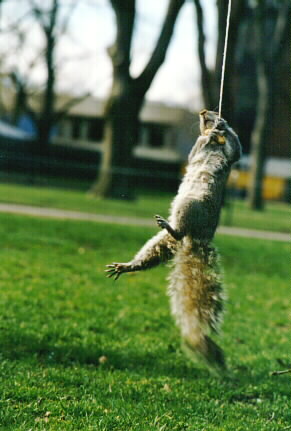
I also found an interesting article on wikipedia. Here's the link: http://en.wikipedia.org/wiki/Squirrel_fishing
Look at these two links for pictures: http://www.wafu.ne.jp/~yaz/en/squirrel_fishing.html
http://www.wafu.ne.jp/~yaz/gallery/Squirrels1997q3/
I thought this picture was the best:

Thursday, November 8, 2007

Marine Ecology

So, after finishing studying about mammals etc, I studied about marine
ecology. Note: This may seem a bit disjointed, but that's because I
copied this from the summary of the chapter I did.
The study of the relationship between an organism and its environment
is called ecology. The nonliving part of the environment is called the
abiotic part and includes the physical and chemical features. The
living part of the environment is the biotic part. When organisms in
an ecosystem reproduce under optimal conditions so that the number of
new offspring is greater than the number of dying adults, the
population undergoes an explosion. The largest population size that
can be supported by a specific area with its available resources is
the carrying capacity of that area. All resources such as nutrients,
light, and space must be present for a population to exist there. If
one of these components is scarce or missing, it is called a limiting
resource. When individuals of the same species compete over available
resources, it is called intraspecific competition. When two different
species compete over available resources, it is called intrerspecific
competition. An organism's niche includes its feeding habits,
requirements for a living space, reproductive strategy, and its
behaviors. Species can use strategies such as speed, defense, and
hiding to avoid becoming prey. Predators use methods such as
camouflage and lures to draw their food closer.
A close living association between two species is called symbiosis.
The larger individual, called the host, lives in close association
with the smaller individual, called the symbiont. When one species
benefits from the relationship and the other is not affected, it is
called commensalisms. When one species benefits and the other is
harmed, it is called parasitism. Mutualism is where both organisms
benefit from living in close association with one another. Autotrophs,
such as algae, get energy from their environment and use it to make
their food. Heterotrophs, such as fishes, obtain their energy from
feeding on algae or other species like themselves. The trophic
relationships in a food chain begin with the primary producers that
make their own food. They are fed upon by the primary consumers. These
are fed upon by the secondary consumers, which are preyed upon by the
tertiary consumers. Since there is usually more than one type of
primary producer, and there are many consumers that feed on more than
one of them, a food chain does not accurately depict what happens in
an ecosystem.
A food web takes into account things such as organisms feeding on many
types of other organisms and changing their feeding habits as they get
older. An Ecological pyramid illustrates the fact that 80-90% of
energy is lost from one trophic level to another. This is not lost to
the ecosystem, however, because much of the unused energy is bound up
in detritus, consisting of dead organic matter and the decomposing
organisms living in it. Many organisms feed directly on this material,
bringing the energy bound up in it back into the food web. The rate of
photosynthesis carried on in an ecosystem is its productivity. During
photosynthesis, inorganic carbon is fixed into organic carbon via a
process called carbon fixation. The two ways to measure productivity
are the traditional method, determining the amount of oxygen produced
in an area, and the more recent method, a light and dark bottle
technique. The first method measures oxygen levels used by producers
and indirectly determines production. The second method measures
radioactive carbon population. Primary productivity does not
necessarily determine the population of phytoplankton in an area. Some
species may be highly productive while others may not. In the carbon
cycle, primary producers take dissolved carbon dioxide from the water
and use sunlight and water to convert it into oxygen and sugars. This
is known as carbon fixation. The carbon, which is now part of an
organic molecule, is eaten by herbivores, which are eaten by
carnivores. At the same time, all of these organisms are burning their
food by respiration and are putting inorganic carbon back into the
environment in the form of carbon dioxide. In the nitrogen cycle,
gaseous nitrogen from the atmosphere dissolves into the water where
some types of blue green bacteria convert it into usable organic
forms. This is called nitrogen fixation. Primary producers use these
organic forms, especially in the form of nitrate, and pass them along
the food web.
At the boundary between land and sea is the shallow intertidal zone.
It is exposed to air at low tide and under water at high tide. Above
this zone is the splash zone that is never under water but is exposed
to salt spray. Below these zones is the inner shelf that is always
underwater and is the area where light can penetrate through the water
down to the sea floor. All three of these zones make up the photic
zone, where light is intense enough for photosynthesis to occur. All
zones between the photic zone are in the aphotic zone where there is
little or no light. The shallowest area here is the outer shelf that
extends to the edge of the continental shelf. Where the continental
shelf drops to the deep ocean it is the bathyal zone. Organisms that
live on the ocean bottom are benthic. Organisms that live in the water
column are pelagic. Among this second group are the plankton that
cannot swim against the ocean currents and the nekton that can swim
against the current flow. The two zones that divide the areas of the
pelagic water column are the neritic zone which is the area over the
continental shelf, and the oceanic zone which represents the other
pelagic areas of the ocean.

Thursday, November 1, 2007

Yeah, Another Battle Report

Assault on the Orcs

Description

The last alliance is preparing for their final battle. Elven scouts have reported that there is an Orc fortress nearby, inhabited by many Orcs, and several Trolls. Gil-Galad, hearing this, has decided to destroy this fortress first before moving on to fight Sauron's main army. He and Elendil march out with a group of Elves and Men to destroy this fortress.

Forces

Mordor Outpost

47 Mordor Orcs, 16 with spear, 15 with sword and shield, 8 with two-handed weapon/axe, 8 with bows

1 Mordor Troll Chieftain

1 Cave Troll with Spear

1 Mordor Orc Captain with sword and shield

4 Goblins, 2 with spear, 2 with sword and shield

5 Warg Riders, 2 with spear, 1 with sword and shield, and 2 with bow

1 Orc Captain mounted on a Warg, with sword and shield.

Elves and Men

Gil-Galad

Elendil

14 Gondorians with sword and shield

3 Gondorians with spear and shield

10 High Elves with sword

14 High Elves with bows

1 High Elf captain with sword

1 Gondorian captain with sword and shield

4 of the Gondorians with sword and shield are carrying a battering ram

The Elves and Men also have two ladders.

Objective

The first force that completely destroys the opposing force wins.

Special Rules

Wargs

Sauron, hearing of the impending attack on the Orc fortress, sends five Warg Riders with an Orc captain wounded on a Warg to lead them. They come in-game at the opposite edge of the board from the fortress on the 20th turn, and can move as usual on that turn.

Pre-Game Thoughts

Mordor Orcs

Although I may outnumber my opponent and have the defensive stronghold, I don't have any heroes that will be able to stand up to Elendil and Gil-Galad at the same time. I'll need to use my numbers to my advantage, and not get caught in the tunnel between the gate and the courtyard. I'll leave my archers and my Orcs with two-handed swords/axes up on the top of the wall with the Orc captain to stop the attackers from taking the wall.


Elves and Men

I'll need to use all my archers to my advantage, so I'll send them up to take the walls with the Elven and Gondorian captains. I'll send the main force straight at the gate, with Gondorian soldiers with shields in front to protect the battering ram. Once the gate is down, I'll send Gil-Galad and Elendil in first with the Elves to support them.

Turn 1

All of the Elves and Men charge forward. Since neither side was in range, no arrows were fired.

Turn 2

Once again, all of the Elves and Men charged forward, with only eight Elven archers moving half of their distance so as to fire in the shoot phase. Fire they did, and they killed two Orc archers. The Orcs were not as fortunate in their archery.

Turn 3

Once again, the Elves and Men charge forward, with the archers staying back. One Orc archer is picked off this turn, while no Elves or Men are killed by the Orcs.

Turn 4

The ladders go up finally. The battering ram is in position, ready to hit the gate next turn. The archers are ineffective this turn.

Turn 5

Although the Orcs gain priority, they fail to knock the ladders down, and so the Elven and Gondorian captains charge up into combat. The Elven captain takes down an orc, while the Gondorian captain gives the Orc captain a wound; he saves it by using his only fate and one of his two might points. The battering ram does no damage this turn.

Turn 6

The Elves and Gondorians gain priority; the battering ram is again ineffective. Up on the wall, there is more fierce fighting as the Elven and Gondorian captains fight onto the walls along with several elven archers. No more Orcs are killed, but the Orc captain receives another wound. He only has one left now.

Turn 7

Even though the Orcs gain priority, an Orc and the Orc Captain are both killed. The Elven captain loses his fight and receives a wound; fate is not smiling on him, however. The battering ram again bounces harmlessly off the gate.

Turn 8

The Elves and Men gain priority, and two Orc archers and another Orc are killed. The battering ram does no harm again. (A bunch of 1's L)

Turn 9

The fight on the wall continues; this turn two Orcs and one Elf archer are killed. The battering ram is once again useless against the gate.


Turn 10

The Orcs are pushed back even further on the wall; four Orcs are killed this turn. The battering ram fails to do anything to the gate again.

Turn 11

Another Goblin is cut down on the walls. The battering ram finally does some damage to the gate this turn also.

Turn 12

An Orc is cut down by an Elven archer on the walls. An Orc archer behind the Orcs fires at point blank range into an Elven archer and kills him. The battering ram fails this turn.

Turn 13

The last two Orcs are cut down on the walls. The Elven archers get into position for what they're there for: pouring down arrows on the Orcs massed below. However, they fail miserably this turn and don't kill any orcs. The battering ram is successful again this turn.


Turn 14

The battering ram finally succeeds in bashing the gate down. The Elven archers fire a volley at the Mordor Troll Chieftain, hoping to wound him, but fail.

Turn 15

With the gate down, the main groups of Orcs and Men and Elves come together in combat. The Troll Chieftain charged into combat with Gil-Galad, two Elves, and two Gondorians helping the Elves with their spears; somehow, the Troll Chieftain won his combat, but failed to wound Gil-Galad. Elendil managed to give the Cave Troll one wound. Two Orcs are killed by the Elven archers.


Turn 16

Although the Troll Chieftain only faces Gil-Galad, one Elf, and one Gondorian, he still loses his fight and is wounded once; fate is smiling on him, and so he does not lose it. The Cave Troll manages to win his fight against Elendil, and gives him one wound, which Elendil saves by fate. Two Orcs are picked off by the Elven archers.

Turn 17

The Men and Elves gain priority, and the Troll Chieftain receives another wound. However, the Cave Troll beats back Elendil and gives him two more wounds, leaving Elendil with only one wound. Once again, the Elves pick off two Orcs.

Turn 18

This turn, the Cave Troll was given yet another wound; the Troll Chieftain also lost a wound. However, the Elven archers were ineffective this turn in their archery.

Turn 19

The Good side gained priority; Elendil finally finished off the Cave Troll, and the Troll Chieftain received his next to last wound. Two more Orcs were killed by the Elven archers.

Turn 20

Finally, the Warg Riders arrive, but are still so far away from the combat that the Elven archers cannot reach them. Three Orcs are killed in combat, along with the Mordor Troll Chieftain. An Elven Swordsman is killed also.

Turn 21

Although the Men and Elves gain priority, Elendil is still attacked by five Orcs. However, he wins the fight and kills one of them. A Warg Rider is picked off by the Elven archers. Three other Orcs are killed in the fight at the gate in exchange for only one Elven swordsman.

Turn 22

The Orcs gain priority again; the Warg Riders make a serious blunder by charging as far as they can towards the Gondorians, but only being able to get the Captain into combat. This allowed the rest of the Gondorians to charge upon the Warg Riders. One Warg Rider was killed in exchange for three Gondorian. Five Orcs were killed in the gate battle, in exchange for only one Gondorian Spearman.

Turn 23

The Orcs again got priority; however, another Warg Rider was killed, in exchange for only one Gondorian. Elendil is almost killed in the combat at the gate, and Gil-Galad receives a wound which he fails to recover with fate. Nobody else is killed.

Turn 24

The Orcs again gain priority; one Warg Rider, one Orc, one Elf Warrior, and two Gondorians are killed. Also, Gil-Galad is surrounded and finished off.

Turn 25

The Men and Elves gain priority. The last Warg Rider and Orc Captain are surrounded and cut down. At the gate, three Orcs are killed in exchange for only one Elf.

Turn 26

The Orcs are finally taken down to 25% of their original forces, leaving the Elves and Men with a major victory.

Thoughts

I think I made this scenario too favorable to the Good side. I think I'll tweak it some, and probably put a Ringwraith and Witchking in next time I play it.

Sorry there aren't any pictures for the last couple of turns, they got deleted by accident.

Tuesday, October 23, 2007

Birds and Other Creatures (including orcs)

So, more marine stuff. There are many birds that are marine. Marine birds are present in a wider array of sea environments than marine reptiles because they are endothermic and extremely mobile. Most birds waterproof their feathers by covering their feathers with oil which they get from an oil gland on their beak. They also have salt glands. A bird is considered a marine bird if it spends a majority of its life at or near the sea and feeds on marine life. The shape of their beaks plays an important part in what they eat. Gulls are the most common of the sea birds. They are omnivores, feeding on whatever they can catch or scavenge. Terns look like gulls but have forked tails and straight, narrow beaks. Puffins and razorbills live in colder waters and dive into the water for their prey. Penguins can also swim underwater; they cannot, however, fly. Unlike other flying birds, their bones are solid and much heavier, where as the other birds have hollow bones.

Shearwaters, petrels, fulmars, and albatrosses are long-winged water birds that spend most of their time flying over the oceans of the world. They only come to land for the mating season. Pelicans, cormorants, and gannets are distinctive because they have webbing between all of their toes, while most other birds only have webbing between three of them.

So, on to the final class of marine vertebrates: class Mammalia. Order Cetacea contains dolphins, porpoises, and whales. Order Pinnipedia contains seals and sea lions. Order Sirenia contains manatees and dugongs. Dolphins, porpoises, and whales are members of order Cetacea; they spend their entire lives in the water. They swim by moving their bodies up and down, while fishes swim by moving their bodies side to side. The creatures in this order can be divided into two major groups: toothed whales, and baleen whales. Toothed whales feed on fish, squid, and other animals. Baleen whales have 300 to 400 rows of horny plates called baleen that hang down into their mouths. These are used to filter the plankton from the water. Pinnipeds are known for their ability to perform echolocation. This is a method of analyzing sound waves to locate objects in the water column. It is made by the air sacs off the airway to the blowhole. The sounds come from relaxing and contracting these muscles. The nasal plugs control air pressure. The clicks are aimed forward toward the front of the skull and focused out of the head by the whale's melon. Sounds returning are received by the lower jaw, which transmits the vibrations to the inner ears.

Order Sirenia contains creatures that are large with a pair of front flippers and a dorso-ventrally (up and down) flattened, paddle-shaped tail. They are slow-moving, docile, and herbivorous.

Order Pinnipedia contains creatures that spend most of their time resting on rocky shores or swimming and feeding in the ocean. They are all carnivorous, feeding on fish and squid. Sea lions and seals differ in two ways. First, sea lions have an external ear, while seals only have a hole on the side of their head. Second, sea lions can walk on land by moving its rear flippers forwards. Seals can only crawl on land, because it cannot move its rear flippers forwards.

Order Carnivora contains two sea mammals: sea otters and polar bears. Sea otters eat sea urchins. Polar bears spend their time either in the water or on the floating ice on the Arctic. They hunt seals.

Here are the pictures:

Penguins:


Whale:


Sea lions:


Polar Bear:


Sea Otter:


Manatee:

And here are my orcs that I finally finished. Be sure to click on the picture to get a bigger picture.