JD's gallery: http://www.thepalantir.org/photopost/showgallery.php?ppuser=575&cat=500


Almost done with this module :) I studied two more phylums in this module. These were: Phylum Echinodermata, and Phylum Chordata (I didn't study all of the last phylum).
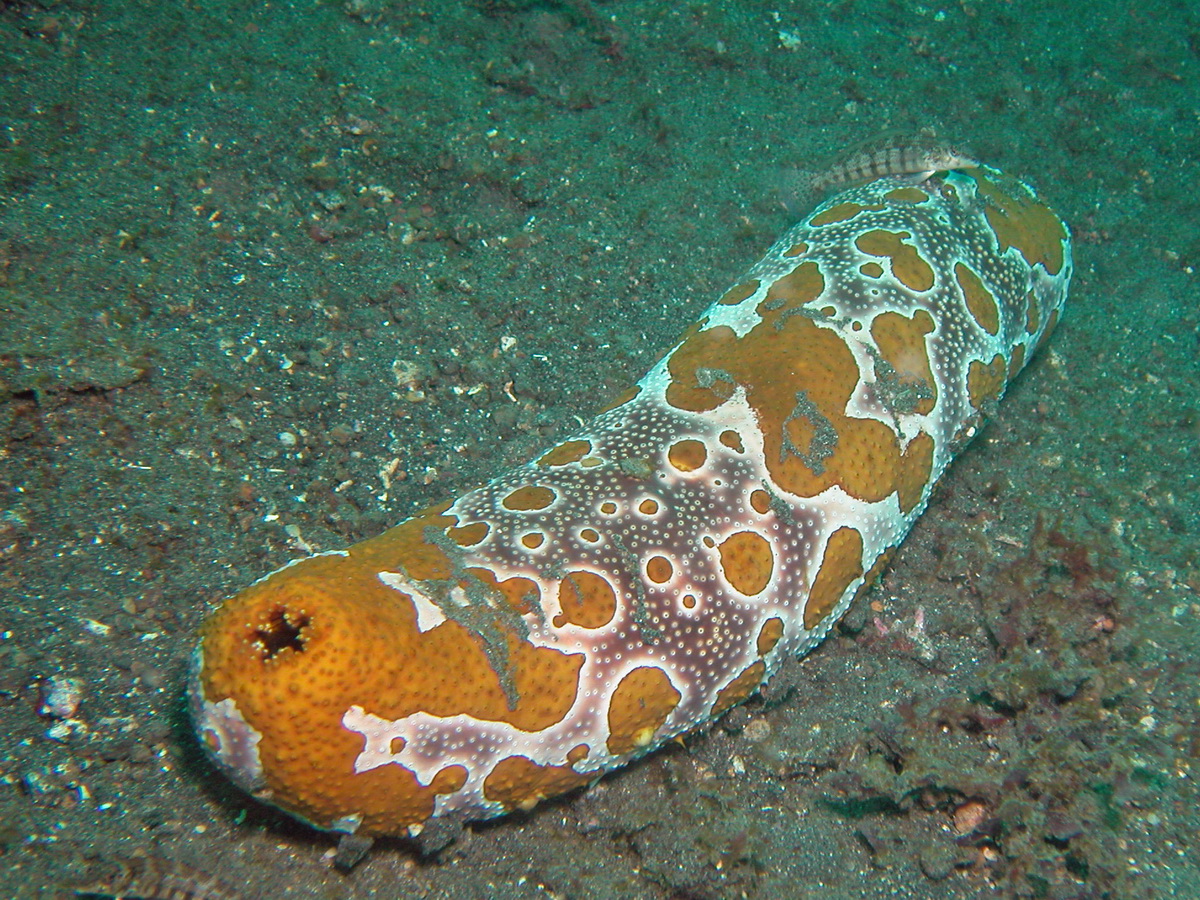
Phylum Echinodermata contains sea stars, brittle stars, sea urchins, sea cucumbers, sea lilies, and like creatures. Echinoderms are bilaterally symmetric. Although echinoderms lack eyes and brains, they are complex organisms. They have a complete digestive tract, and their skeleton is actually an endoskeleton, developing from the internal tissues of the animal. They have an internal water vascular system which is a network of water-filled canals used for locomotion and feeding. The canals operate tube feet that are on the bottom of the echinoderms; they extend for locomotion as well as sensory, respiratory and excretory duties. Sea stars have, on the bottom of each arm, a channel called an ambulacral groove; the tube feet protrude through this. Most sea stars are carnivorous and prey on snails, barnacles, and bivalves. It's very interesting and cool how a sea star eats a clam: the sea star goes over the clam and finds the tiniest opening in the clam. It then pushes its stomach out of its body and through that opening, and digests the clam without having to eat it. Sea stars are in class asteroidea, brittle stars are in class Ophiuroidea, class Echinoidea contains sea urchins, sea biscuits, and sand dollars, class holothuroidea contains sea cucumbers, and class crinoidea contains feather stars and sea lilies. Echinoderms' body cavity is filled with a coelomic fluid that transports nutrients and gases throughout their bodies. Echinoderms can also regenerate their body parts. For example, fishers who caught clam saw that sea stars were eating a lot of them, so they caught a bunch of sea stars and cut them up and threw them back in. However, the sea stars all regenerated their entire bodies from the parts that the fishers through in, so there were even more sea stars than before.
Here are some echinoderm pictures:
Sea cucumber:
Sea urchin:
Sea star:
The last phylum I studied in this module was Phylum Chordata, although I didn't study all of it. This phylum is a diverse group, ranging from tiny gelatinous zooplankton to large fishes and whales. There are both vertebrates and invertebrates in this phylum. However, they all have several things in common: a notochord during some part of their life cycle, which is a flexible supportive rod that runs the length of the body, a hollow dorsal nerve cord that runs along the dorsal length of the animal. They also all have folds of skin located along the neck during their embryonic development. These are called pharyngeal pouches. Subphylum Urochordata is all invertebrates and marine, and its members are called tunicates. As adults, these animals cover themselves with a leather-like "tunic." Sea squirts and scidians are in this subphylum. They filter the water for food by taking it into their mouth through a siphon and passing it through a ciliated sac. During their larval stages, sea squirts swim around, then attach themselves to the bottom of the ocean floor. Subphylum Cephalochordata contains lancelets. They are shaped much like fish. They are usually about the size of a quarter or a bit larger. Pictures:
Sea squirts:
I couldn't find any pictures of lancelets though. Sorry :(
Most of the marine arthropods are in class Crustacea. These creatures have gills for obtaining oxygen, special appendages for swimming, and an exoskeleton. They also have two pairs of antennae to sense their surroundings. Arthropods have two body segments: head, thorax, and abdomen. The head and thorax of krill and some other larger crustaceans are fused together, forming a cephalothorax. It is covered with a carapace, which protects the anterior part of its body. Shrimp, lobsters, and crabs belong to the order Decapoda, and are the largest of marine arthropods. They have five pairs of legs for walking. Shrimp and lobsters have a long abdomen, and many live on the ocean bottoms where they scavenge for leftover bits of food. Some shrimp feed on the parasites of fish; they set up a "cleaning station" where a fish swims up and the shrimp eats the parasites off of him, giving the shrimp food and the fish protection from parasites.
Bottom-dwelling crustaceans, like the shrimp and crabs, have appendages near their mouths called maxillipeds; they maneuver food into the mouth. Most crustaceans have teeth made of chitin, but they are inside their stomach. They also have an open circulatory system. They also have compound eyes. There are many types of planktonic larvae, depending upon the type of crustacean. Class Pycgnogonida contains sea spiders, class Merostomata contains horseshoe crabs, which are not really true crabs.
A blue crab:
Shrimp krill:
Lobster:
Sea spider:
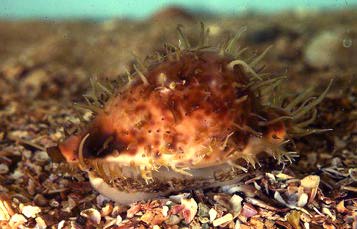
Class Gastropoda contains organisms commonly known as snails. Many snails have a horny plate, called an operculum. Marine Gastropods contain abalones, helmet shells, and nudibranches. Class Bivalva is made up of organisms such as mussels, clams, oysters, and scallops. Bivalves have a hinged, two-pieced shell. Some bivalves, such as clams, burrow into the sand with their muscular foot. Class Cephalopoda contains squid, octopuses, cuttlefish, and nautilus. They are carnivorous predators with sucker-lined tentacles, well-developed sense organs, and relatively large brains. Camouflage is achieved as a result of chromatophores, which can change the animals' color to match their surroundings. Because they do not have an external shell, cephalopods can forcefully contract their mantle cavity, shooting out a jet of water, which propels them backwards. Other mollusks include chiton and tusk shells. To become more familiar with the anatomy of a clam, I dissected a clam during this module. Here are some pictures:
A giant clam:
A cowry:
Some sea slugs:
An octopus:
I studied phylum Ctenophora in the last module, which contains what are commonly called comb jellies. They are small and planktonic, preying on even smaller plankton. They have eight rows of ciliary combs located vertically within their bodies. They can move their bodies with their combs. Comb jelly:
I also studied several other phylums, including phylum Platyhelminthes, Nemertea, and Nematoda. Phylum Platyhelminthes contains flatworms. Flatworms have the simplest organization of organs and organ systems of all bilaterally symmetric animals. They have a simple brain, which is basically just a collection of nerves in the head, and many nerve cords running through the length of the body. Several members of this phylum are parasites, especially tapeworms and flukes. The tapeworm resides inside the intestines of many species. They rely on their host to digest food for them, and they can absorb the needed nutrients directly into their bodies. Phylum Nemertea contains ribbon worms. They have a circulatory system that transports nutrients and oxygen via blood. They have a proboscis which is used for defense and to capture prey. Phylum Nematoda contains roundworms. Many of them are parasitic. Phylum Annelida contains segmented worms and have a distinct circulatory system for transportation of nutrients and gases.
The last organism I studied is the lophophorates. They are suspension feeders, which means they obtain food from plankton suspended in the water. They have bilateral symmetry, and their gut is U-shaped. Some lophophores are lamp shells, which look like clams, but are not true clams, moss animals, which form colonies of interconnected individuals, and worms that build tubes made out of sand grains. A lamp shell:
In school, I've been taking a Marine Biology class, so I guess I'll talk a bit about what I've been learning there. During the last module I finished, I learned about Marine Invertebrates, which are animals that do not possess a backbone.
One of the phylums that I studied was Phylum Porifera. This phylum contains sponges etc. Sponges grow in an amazing variety of shapes, sizes, and colors, and can range in size from less than a few centimeters to many meters tall. They do not move because they are attached to a bottom surface, which is called a substrate. Sponges have many pores, holes, and channels on their bodies. These holes allow water to enter and move through a series of canals within the organism. Once inside, suspended plankton and bits of organic material are filtered out and consumed by the sponge.
Inside the canals in the sponge's body are collar cells. Each of these cells has a flagellum that moves to create currents of water which flow into the sponge. The sponge also has an osculum on the top of it, which is a large opening through which filtered water is expelled. Sponges have spicules inside them which give them their shape and help them stay rigid. To observe a sponge, I did a long, difficult, and tedious dissection, in which I took the sponge and cut it in half. A tube sponge:

I also studied phylum Cnidaria during this module. This phylum contains jellyfish, corals, and sea anemones. Organisms in this phylum have one of two basic body forms: poly or medusa. The polyp form is an attached stage, while the medusa is a free-swimming stage. Cnidarians have a jelly-like body layer called the mesoglea. Almost all cnidarians are carnivores. In this phylum are classes hydrozoa, scyphozoan, and anthozoa. Class Hyrdozoa contains the Portugese Man-o-war, which is not one organism, but a colony of many different organisms. Class Scyphozoa contains the larger jellyfishes, and class Anthozoa contains corals. A jellyfish: