So, I just returned from various adventures overseas. These adventures started off with rising at 3 AM on Monday, two weeks ago. We left our house at 4 and arrived at the airport around 5:15 AM. We had plenty of time to check in, get our boarding passes, go through security, and find our gate. The flight from Tulsa to Newark was about 2-3 hours long and was quite fun since I got the window seat and I got to watch the sun rise. We arrived in Newark between 10-11 AM their time. We had a 10 hour wait until our next airplane. That wait consisted of: reading books, eating lunch, reading some more books, listening to music, watch airplanes and helicopters come and go, eat dinner, find out our gate had been changed again, walking to the opposite side of the terminal, and reading some more books until our flight was ready to leave. We left at 9 PM Newark time and arrived in Belfast at 7 AM their time. So, of course, the only sleep I got that night was the sleep on the airplane, which was about an hour or so. They were showing a movie about Jane Austin (which wasn’t too interesting :P).
When we got off the plane in Belfast, the first thing I noticed was that it was cold. After picking up our luggage, we met Evelyn (My sister, if you didn’t notice) outside the airport. From there, we caught a bus into the City Centre in Belfast, where we walked to Renwick house where Evelyn lives. Evelyn has a large room which she shares with Emmaline, who was away for Easter break. There were only two heaters in the room which were on timers, so it was quite cold in the mornings. Mommy and Evelyn got to sleep on beds while I got an air mattress (which wasn’t too bad except I kept falling off it in the middle of the night). There was a shower in the room but no toilet. After unpacking and stuff, we looked around the rest of the house, met a few of the other people there, walked around Queen’s University and saw the Botanic gardens, and generally just settled in. We ate lunch and dinner in the kitchen (which was only heated by one heater and so was cold). We watched Ocean’s 11 before going to bed.
The next day, we caught a bus to the Belfast zoo, where we spent the day. It was kinda cold that day, but the sight was pretty since the zoo was located on a hill overlooking the bay. It was a fairly nice zoo; the sea lions were out swimming about and making their funny barking noises. The penguins were also out and hopping around and yipping at each other as well. On Thursday, we took a 3 hour bus to Dublin. For some reason the bus was unbearably hot. We spent the day in Dublin and took a bus tour of the city. We visited St. Patrick’s cathedral and Trinity University where the Book of Kells was. The bus ride back to Belfast wasn’t quite so warm, but there was a huge traffic jam, so it took more like 4 hours.
On Friday, we didn’t do anything special in the morning, but in the afternoon, we took the train to Coleraine. There, we were met by Evelyn’s roommate’s mother (Mrs. McCollum), who took us to their house, where we stayed until Monday morning. In that family there were three girls and two boys; the boys are twins, Nathanael and Ruben. After we arrived on Friday, Emmaline took us along with Nathanael to see Giant’s Causeway. Although it was extremely windy and extremely cold, it was still fun. On Saturday, Mrs. McCollum took my Mother, Evelyn, Emmaline, Nathanael, and me to Omagh to see the folk park thing. Essentially, we went through a bunch of buildings from Ireland from the 1700’s or so (Buildings like houses, weaver’s houses, etc. Most of the houses were actual houses that had been moved from their original locations). We then went through a ship (Which was missing the mast, so it looked kinda funny :P) and onto America. The houses there were much larger and sturdier. Afterwards, we also went into the museum where they had some things from that time period and lots of stuff about people from Ireland who went to America. We came back through Londonderry from Omagh. There, we stopped and walked around the walls surrounding Londonderry. Londonderry is the only walled city in Ireland or something like that. Of course, the city has outgrown the walls now, but people still walk around on the walls; they even have some cannons up there, although they’re unusable. On Sunday, we went to the church where the McCollum’s go every Sunday. We went for Sabbath School and the service. We went back to their house and ate lunch. In the evening, we went to Ballyclabber for the evening service.
On Monday, we got up nice and early; Emmaline took us to the airport from whence we got an airplane to London. We spent all of that week in London doing various touristy things. After arriving in London, we gathered all of our luggage, got onto a bus which took us on an hour long drive to Victoria station, where we took an Underground to King’s Cross, from whence we walked to our Travelodge nearby. After checking in, we took one of four elevators (which constantly told us “elevator is going up,” or “doors closing,” or “fourth floor,” etc.) to the fourth floor. Our room was on the opposite side from the elevators, so we had a nice walk to find our room. Our room was quite small, with three single beds squeezed in there. After unpacking and settling in, we went downstairs and met some old friends. We went with them to the Tate Modern Gallery, which was quite interesting…*ahem.*
The next morning, my Mother and sister walked down to a small shop where they purchased food items for the rest of the week. After consuming breakfast, we took the underground to a place where we could get tickets for a bus tour. We got off of the tour at Westminster Abbey and St. Paul’s. Both of these cathedrals did not allow pictures to be taken and were not free. Other than that, they were completely different in architecture. The ceiling in the chapel in Westminster Abbey was quite amazing; it was also quite interesting to see all the burial places for important people. St. Paul’s was even cooler because you could climb 430 steps to the top of it and get a nice view of all of London. My Mom didn’t think the climbing part was so fun though.
The next day, we went to the aquarium in the morning. The aquarium was quite nice; it was separated into different zones, each zone with different kinds of fish. They had Pacific tanks, Atlantic tanks, freshwater, etc. They had a quite large tank with 5 or 6 sharks in it :D. After the aquarium, we went to the National Gallery. It was a quite large place and we didn’t spend much time in any of the galleries except the landscape ones and the Impressionistic ones.
On Thursday, we were going to go to Salisbury and see the cathedral and Stonehenge, but we couldn’t find a reasonable way to get out there. Instead, we visited the British museum, which took up most of the day. They had all sorts of stuff from everywhere in the world; from Roman things to Assyrian wall sculptures and Egyptian mummies. On the way back, we went through Kensington Gardens and saw the Prince Albert (At least I think it was Prince) memorial. The Gardens were quite lovely, and I’m sure we could have spent more time. There were a bunch of people out with their little dogs.
On Friday, we took the underground to the Natural History Museum. There, we saw the dinosaur room (Which had some nice dinosaur bones), the room about ecosystems and stuff, the room about insects and spiders, the room about birds and fish (Which had a bunch of stuffed birds and fish and models in there. They even had dodos). After we finished that, we went to the Science Museum (Which was quite close by) and spent a little bit of time there. We saw the exhibit about weather, time, and ships. The ships exhibit was my favorite, since they had a huge collection of model ships from all ages. Some of those models were quite large in size. They had a Viking ship, British ships with cannons, and a huge ship that was used during World War II to carry American troops to Europe (Called the Queen Elizabeth).
On Saturday, we got up bright and early at 4 AM. Our taxi was supposed to come for us at 4:30, but he was 15 minutes early. He took us to Victoria station, where we were supposed to catch a bus. Since we were so early, we caught the bus that was an hour earlier than the one we had planned to catch. The bus took us back to the airport where we caught our flight back to Belfast. From Belfast, we took the bus to the Central Station, and then we walked back to Evelyn’s room. On Sunday, one of Evelyn’s friends took us to their church for the morning service. Afterwards, we went to their house for lunch and the afternoon. In the evening, we went back to the church for the evening service, and then back to their house for supper. We were then driven back to Evelyn’s room. On Monday, the same people graciously gave us a ride to the airport so we wouldn’t have to haul all of our huge suitcases to the bus station. Our flight to Newark was quite nice, but when we arrived in Newark, it was raining quite heavily and was very foggy. When we arrived, we found that, guess what, our flight had already been delayed an hour. Eventually, our flight was delayed two hours, so we ended up staying in the airport again for 9 hours. Our flight to Tulsa arrived around midnight our time, and so we didn’t arrive at home until 1:30 AM or thereabouts.

Thursday, April 3, 2008
England

Saturday, March 1, 2008
Wednesday, February 27, 2008
Cool Deep Sea Stuff
I thought this was the coolest chapter in my Marine Biology book, so I had to share it :). The area beneath the epipelagic (Which is the area around the surface of the water down to around 200 meters) is divided into two areas: the mesopelagic and the deep sea.
The mesopelagic receives enough light for organisms to see each other, but not enough to support photosynthesis. So, as you can guess, there isn't much primary production here, and so there aren't many creatures here. Although phytoplankton can't live here, zooplankton can. They have photophores, which are are organs that produce light (I'll talk more about them later). The mesopelagic also does not receive many nutrients from other ecosystems either. Because food is so scarce here, most creatures need to be able to eat whatever they find. Most creatures use a sit and wait tactic, where they sit around and wait for food to come to them. This is benificial because it doesn't use up much energy and they don't need a lot of muscles. A lot of organisms have large mouths and hinged jaws so they can eat large organisms. Mesopelagic creatures also migrate vertically up into the epipelagic at night to get food and return during day so they aren't eaten.
Many organisms in the mesopelagic are silver, black, red, or transparent. Many fishes use photophores on the undersides of their bodies so that their silhouette, when viewed from below, is broken up. This is called counterillumination. The photophores do not simply turn off and on like light switches, but get dimmer in darker areas, and get brighter in lighter areas. This light is produced by a chemical reaction between luciferin and luciferase. Luciferin reacts with oxygen, and luciferase acts as a catalyst and speeds up the reaction. What's really neat about this light is that it's cool: this light does not produce heat.
The deep sea is similar to the mesopelagic, except more so. There is more pressure in the deep sea, there is absolutely no light here, and there are even less organisms. Many deep sea fishes can eat prey much larger than themselves. On the deep sea floor, the food that floats down from above zones stays there until it is found and decomposed. There are hydrothermal vents in certain areas. These vents are hot, actively spreading rift zones where heated water spews up from the crust. Around these hydrothermal vents live all sorts of creatures. This is because some types of bacteria can produce nutrients from the chemicals spewed from the vents. There are other vents which are called cold seeps, which are cold instead of warm.
So, that's a quick summary of the chapter I just finished in marine biology. Here are some pictures too:
 Anglerfish
 Dragontail Fish
 Threadtail fish
A couple of modules ago, I started raising brine shrimp (also called sea monkeys) for an experiment. The first generation died several weeks ago, and now the second generation is at its height (they're really fun to watch, because their little feet flutter wildly as they swim around :D)
Here are some pictures. They're kind of hard to see, so you might want to right click on the picture and click on view image to get the biggest picture. They're not the little round things (those are the eggs).


And I also finished painting some miniatures recently. Here are pictures:


Wednesday, February 6, 2008
Wood Elves
So...for Christmas, JD got me a box set (24 miniatures) of plastic wood elves. They were very interesting to paint, as I've never painted anything like them before. I thought they turned out fairly well, except some of their faces didn't look very well. Here are a few pictures:


Also, something else I found on randomly browsing the internet. :P
Go to Google and type 'find chuck norris' without the quotes and then hit I'm feeling lucky.


Also, something else I found on randomly browsing the internet. :P
Go to Google and type 'find chuck norris' without the quotes and then hit I'm feeling lucky.
Wednesday, January 16, 2008
Coral Reefs
Yeah, it's been a while. And I've been studying a lot of things in marine biology that I don't really have time to talk about right now. I will, however, talk about something I just finished studying about: coral reefs.
So, you may be wondering, what is a coral reef? Well, it's a bit complicated. What you see, touch, etc. is the limestone "armor" that is secreted around the tiny creatures called corals. Not all of the stuff you feel is made by the corals though. There are other things that make the limestone "armor." Coralline algae also help in making this armor around the coral. Zooxanthellae also play an important part in helping corals get food and stay healthy. Corals can survive without zooxanthellae, but they would be very unhealthy without them. Zooxanthellae provide corals with some of the food they need (through photosynthesis), as well as helping to recycle food and other things. Corals can get food through their mucus, which can trap food and send it to their mouth as well as carry away sediments. Corals come in many different shapes and sizes.
Although you may not think it to look at them, corals are actually quite competitive. If they are fast growing, they will grow over and above other corals, blocking off their sunlight and killing them. Corals also have stinging tentacles that they can send out to attack other corals.
There are many examples of symbiosis in coral reefs. Several of these are: the relationship between cleaner shrimp and larger fishes, zooxanthellae and corals, and clown fish and sea anemones. Another example of symbiosis is between crabs and corals. Crabs help corals by eating the crown-of-thorns sea star, which eats coral reefs; without those crabs, the corals would be killed easily by the crown-of-thorns sea stars.


Wednesday, November 14, 2007
Lotr Miniatures, Pictures
I got some more LOTR miniatures, and of course painted them also. Here are the pictures. Be sure to click on them for a larger picture. Elrond:
High elven spearmen:
Isildur:
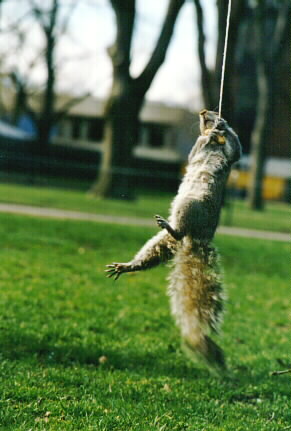
I also found an interesting article on wikipedia. Here's the link: http://en.wikipedia.org/wiki/Squirrel_fishing
Look at these two links for pictures: http://www.wafu.ne.jp/~yaz/en/squirrel_fishing.html
http://www.wafu.ne.jp/~yaz/gallery/Squirrels1997q3/
I thought this picture was the best:


High elven spearmen:

Isildur:

I also found an interesting article on wikipedia. Here's the link: http://en.wikipedia.org/wiki/Squirrel_fishing
Look at these two links for pictures: http://www.wafu.ne.jp/~yaz/en/squirrel_fishing.html
http://www.wafu.ne.jp/~yaz/gallery/Squirrels1997q3/
I thought this picture was the best:
Thursday, November 8, 2007
Marine Ecology
So, after finishing studying about mammals etc, I studied about marine
ecology. Note: This may seem a bit disjointed, but that's because I
copied this from the summary of the chapter I did.
The study of the relationship between an organism and its environment
is called ecology. The nonliving part of the environment is called the
abiotic part and includes the physical and chemical features. The
living part of the environment is the biotic part. When organisms in
an ecosystem reproduce under optimal conditions so that the number of
new offspring is greater than the number of dying adults, the
population undergoes an explosion. The largest population size that
can be supported by a specific area with its available resources is
the carrying capacity of that area. All resources such as nutrients,
light, and space must be present for a population to exist there. If
one of these components is scarce or missing, it is called a limiting
resource. When individuals of the same species compete over available
resources, it is called intraspecific competition. When two different
species compete over available resources, it is called intrerspecific
competition. An organism's niche includes its feeding habits,
requirements for a living space, reproductive strategy, and its
behaviors. Species can use strategies such as speed, defense, and
hiding to avoid becoming prey. Predators use methods such as
camouflage and lures to draw their food closer.
A close living association between two species is called symbiosis.
The larger individual, called the host, lives in close association
with the smaller individual, called the symbiont. When one species
benefits from the relationship and the other is not affected, it is
called commensalisms. When one species benefits and the other is
harmed, it is called parasitism. Mutualism is where both organisms
benefit from living in close association with one another. Autotrophs,
such as algae, get energy from their environment and use it to make
their food. Heterotrophs, such as fishes, obtain their energy from
feeding on algae or other species like themselves. The trophic
relationships in a food chain begin with the primary producers that
make their own food. They are fed upon by the primary consumers. These
are fed upon by the secondary consumers, which are preyed upon by the
tertiary consumers. Since there is usually more than one type of
primary producer, and there are many consumers that feed on more than
one of them, a food chain does not accurately depict what happens in
an ecosystem.
A food web takes into account things such as organisms feeding on many
types of other organisms and changing their feeding habits as they get
older. An Ecological pyramid illustrates the fact that 80-90% of
energy is lost from one trophic level to another. This is not lost to
the ecosystem, however, because much of the unused energy is bound up
in detritus, consisting of dead organic matter and the decomposing
organisms living in it. Many organisms feed directly on this material,
bringing the energy bound up in it back into the food web. The rate of
photosynthesis carried on in an ecosystem is its productivity. During
photosynthesis, inorganic carbon is fixed into organic carbon via a
process called carbon fixation. The two ways to measure productivity
are the traditional method, determining the amount of oxygen produced
in an area, and the more recent method, a light and dark bottle
technique. The first method measures oxygen levels used by producers
and indirectly determines production. The second method measures
radioactive carbon population. Primary productivity does not
necessarily determine the population of phytoplankton in an area. Some
species may be highly productive while others may not. In the carbon
cycle, primary producers take dissolved carbon dioxide from the water
and use sunlight and water to convert it into oxygen and sugars. This
is known as carbon fixation. The carbon, which is now part of an
organic molecule, is eaten by herbivores, which are eaten by
carnivores. At the same time, all of these organisms are burning their
food by respiration and are putting inorganic carbon back into the
environment in the form of carbon dioxide. In the nitrogen cycle,
gaseous nitrogen from the atmosphere dissolves into the water where
some types of blue green bacteria convert it into usable organic
forms. This is called nitrogen fixation. Primary producers use these
organic forms, especially in the form of nitrate, and pass them along
the food web.
At the boundary between land and sea is the shallow intertidal zone.
It is exposed to air at low tide and under water at high tide. Above
this zone is the splash zone that is never under water but is exposed
to salt spray. Below these zones is the inner shelf that is always
underwater and is the area where light can penetrate through the water
down to the sea floor. All three of these zones make up the photic
zone, where light is intense enough for photosynthesis to occur. All
zones between the photic zone are in the aphotic zone where there is
little or no light. The shallowest area here is the outer shelf that
extends to the edge of the continental shelf. Where the continental
shelf drops to the deep ocean it is the bathyal zone. Organisms that
live on the ocean bottom are benthic. Organisms that live in the water
column are pelagic. Among this second group are the plankton that
cannot swim against the ocean currents and the nekton that can swim
against the current flow. The two zones that divide the areas of the
pelagic water column are the neritic zone which is the area over the
continental shelf, and the oceanic zone which represents the other
pelagic areas of the ocean.
Subscribe to:
Posts (Atom)