
Most fishes in creation are in class Osteichthyes. They are called bony fishes. Their skeletons are made at least partially of bone. Bony fishes have scales formed from bone on their outside, unlike cartilaginous fishes. They use what is called a swim bladder or air bladder to stay afloat. Sharks use a large liver to keep up. A fishes' body shape is determined by its lifestyle. There are various types of body shapes; they are: ray-like, flat, box-shaped, disc-shaped, tapered, elongated, and eel-like. Fishes use different colorations for camouflage, disguise, or advertisement. Fishes have myomeres, which are bands of muscle along the sides of fishes used by them for locomotion.
Fishes have a countercurrent system of blood flow. In this system, the blood in the gills flows in the opposite direction from that of the water. Because of this system, there is oxygen diffusion occurring along the entire gill as the water moves over it.
After studying the fishes, I studied the rest of the Marine Vertebrates. The first class I studied was Class Reptilia. This contains, of course, reptilians, like alligators, lizards, snakes, and turtles. Marine reptiles breathe air with their lungs, and so they must regularly return to the surface for air. Unlike a land turtle, a sea turtle cannot pull its head and appendages all the way into its shell (or carapace). In addition, sea turtles have flippers as opposed to thick, clawed legs of land turtles. Sea turtles sleep by sleeping for an hour and then going up to the surface for air, and then going to sleep. Other kinds of sea turtles sleep at the surface with their nostrils about the surface so they can breathe.
Sea snakes look a lot like land turtles except for a laterally flattened tail that aids in their swimming. They are all extremely poisonous, and are more common than the poisonous land snakes. The bite of a sea snake can kill a human, although they rarely attack humans. Marine iguanas do not live exclusively in the ocean, but spend much of their time on the shore so as to keep their bodies warm. They live on the Galapagos Islands off the western coast of South America.
Some pictures:
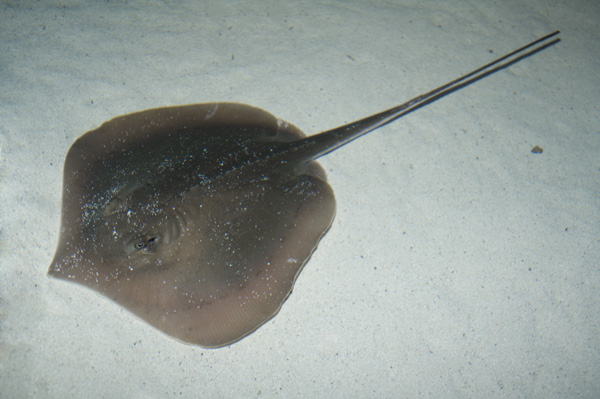
Stingray
My favorite type of fish, the clown fish:

And here's a cute picture that was on my iGoogle as the random picture of the week.
The one on the right looks like Curly (Laura's guinea pig)
http://www.pmstudios.co.uk

2 comments:
Awww.... toot widdl piggls. :o)
*hem*
Thanks for writing down more marine biology facts! I don't think I'd like to be a sea turtle, having to be interrupted in my sleep every hour or so. Rays are so much fun to watch swim. What do they use the stingers in their tails for if not for catching food?
They use their stingers for defense also as well as catching their food. Not all rays have those stingers, if I remember correctly.
Post a Comment